
PPAP
PPAP ist die Abkürzung für
Production Part Approval Process
(Produktionsteil-Freigabeverfahren)
Our content sections
Glossary article
PPAP (Production Part Approval Process)
Was ist ist PPAP?
PPAP – Definition:
PPAP ist ein standardisierter Prozess für ein strukturiertes Bemusterungsverfahren für Serienteile.
Die Abkürzung PAPP steht für den englischen Begriff Production Part Approval Process.
Im Deutschen spricht man vom Produktionsteil-Freigabeverfahren, auch Produktionsteil-Abnahmeverfahren genannt.
Das PPAP-Verfahren wird vor allem im Bereich Automotive eingesetzt, zunehmend aber auch in anderen Bereichen wie Luftfahrt und Medizintechnik.
Die Abkürzung PPAP steht für Production Part Approval Process.
PPAP – Bedeutung:
Das Freigabeverfahren PPAP dient, ähnlich wie das Freigabeverfahren PPF*, insbesondere in der Automobilindustrie dazu die Produktionsprozesse der Zulieferer sowie die Qualität der von ihnen hergestellten Produkte nachzuweisen.
In der Praxis fordern beispielsweise Automobilhersteller (OEMs) das PPAP-Freigabeverfahren standardmäßig von ihren Zulieferern ein, um eine gleichbleibende Serienqualität sicherzustellen.
PPAP – Bezeichnungen und Zuordnung
- English designation:
Production Part Approval Process - German designation:
Produktionsteil-Freigabeverfahren / Produktionsteil-Abnahmeverfahren - Abkürzung:
PPAP - Verwandte Verfahren:
Produktionsprozess- und Produktfreigabe (PPF*)
- Branchen, die PPAP einsetzen:
Automotive, Luftfahrt, Medizintechnik - Standardnormen- und Regelwerk:
IATF 16949, IS0 9001
*)
Das sogenannte PPF-Verfahren ist wie PPAP eine Vorgehensweise zur Sicherstellung der Qualität, jedoch richtet sich das PPAP-Verfahren nach der amerikanischen Arbeitsgruppe für Lieferantenqualitätsforderungen (AIAG = Automotive Industry Action Group). Wohingegen sich PPF nach der deutschen Automobilindustrie richtet (VDA Band 2).
PPAP / PPF Unterschied
Das vom VDA entwickelte Produktionsprozess- und Produktfreigabe-Verfahren (PPF) sowie der aus Amerika stammende Production Part Approval Process (PPAP) sind in ihrem Ablauf sehr ähnlich. Die Unterschiede der zwei Freigabe-Verfahren PPAP und PPF haben wir in unserem Blogbeitrag PPF vs. PPAP summarised for you.
PPAP
Themenüberblick zum Produktionsteil-Freigabeverfahren PPAP
- Schaubild zur Produktentstehung – sowie dem damit einhergehenden PPAP-Prozess
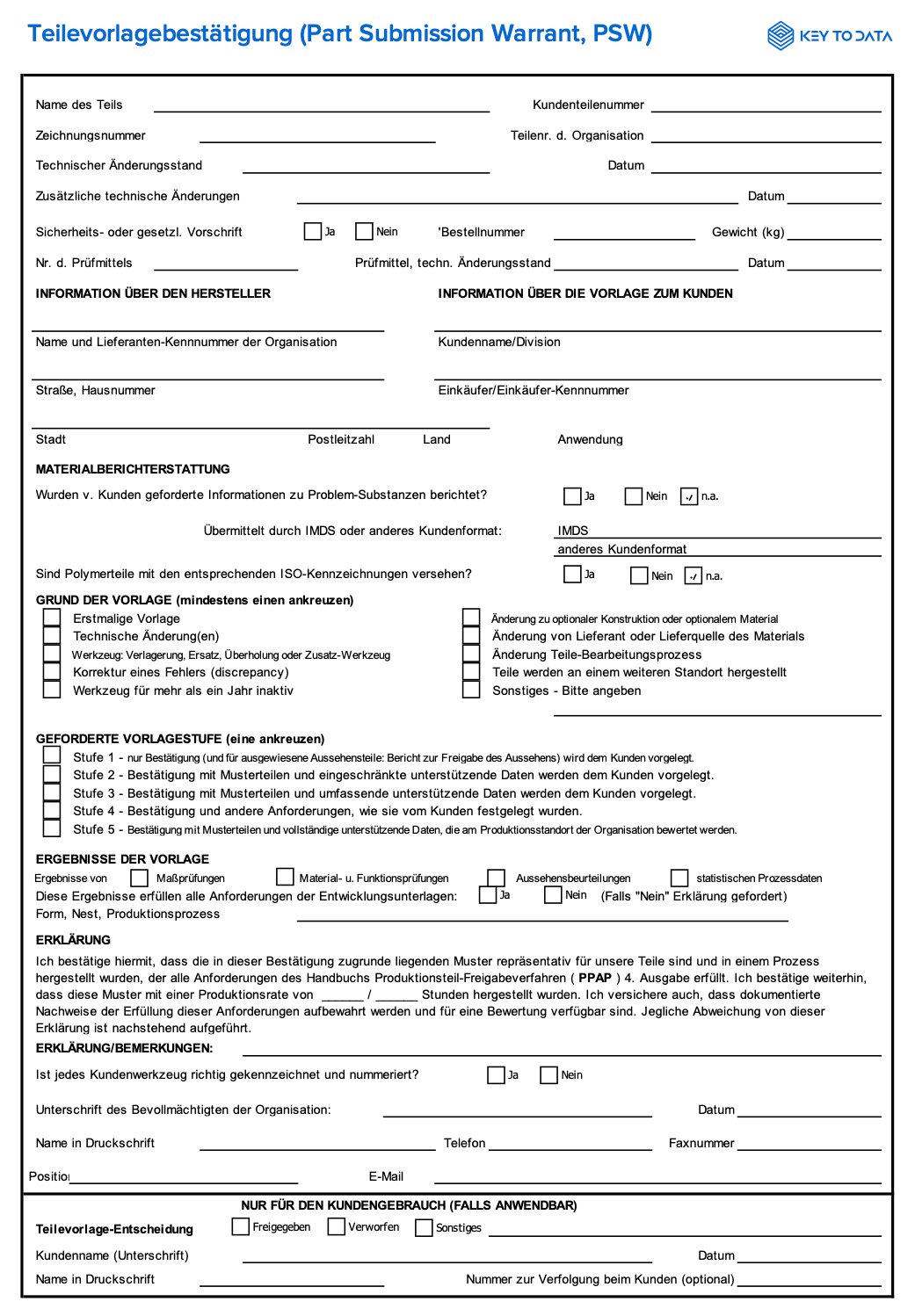
- Teilevorlage-Bestätigung (PSW)
- PPAP Level (Level 1 bis Level 5)
- PPAP-Anforderungen im Detail
- Inhaltsbestandteile des Produktionsteil-Abnahmeverfahren (PPAP)
- Difference between PPAP and APQP
PPF vs. PPAP: Unterschiede zwischen dem Freigabeverfahren PPF und PPAP finden Sie here.
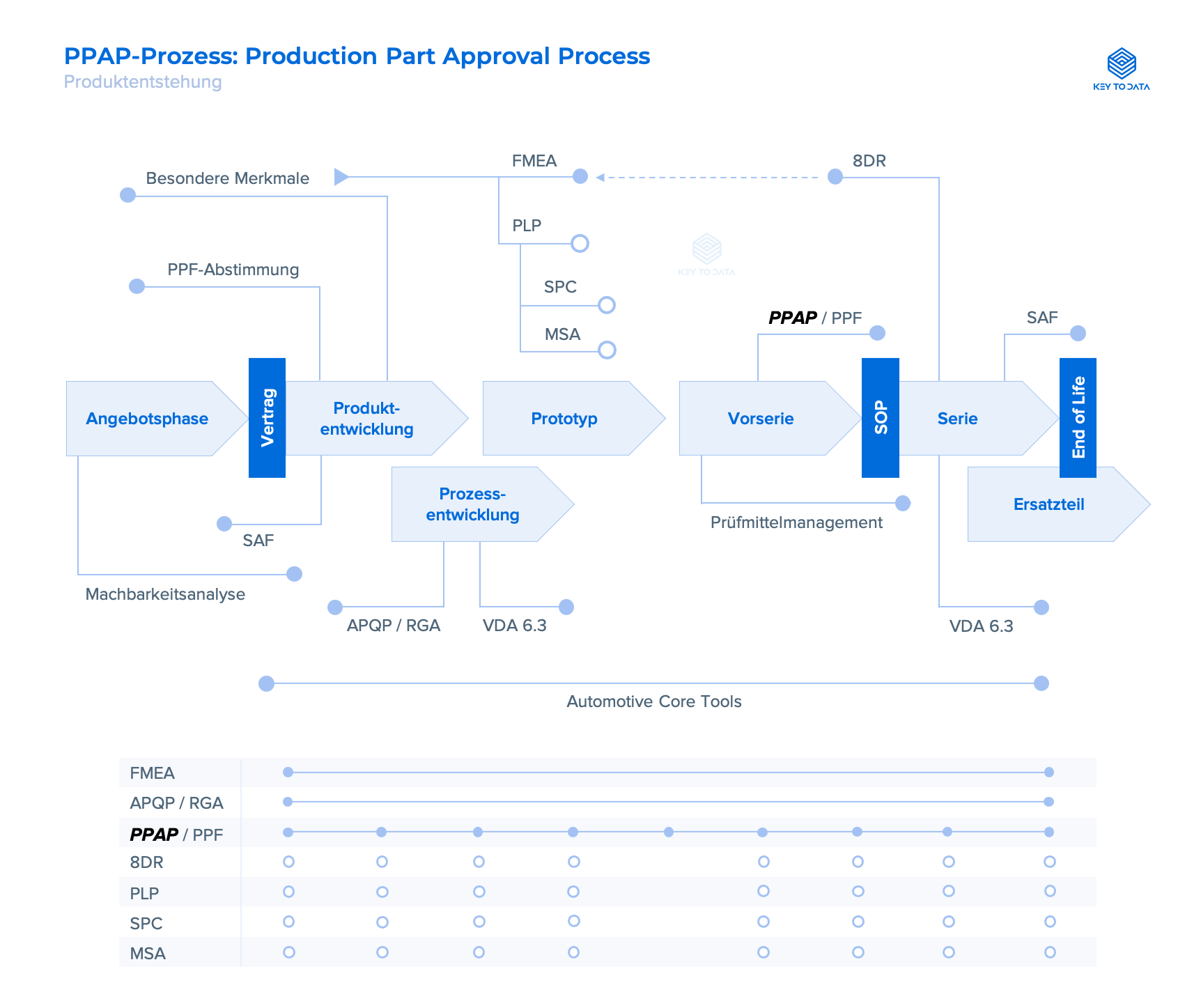
Schaubild zur Produktentstehung – sowie dem damit einhergehenden PPAP-Prozess
Das unten angezeigte Schaubild zur Produktentstehung – sowie dem damit einhergehenden PPAP-Prozess – zeigt wichtige Schritte des Produktionsteil-Freigabeverfahrens im Überblick – beginnend mit der Angebotsphase für ein Bauteil bzw. Produkt über die Produktentwicklung, den Prototypenbau und dessen Prüfung bis hin zur Serienproduktion.
Das Schaubild zur Produktentstehung können Sie als PDF download free of charge by clicking on the button. The download will open in a new tab.

Teilevorlage-Bestätigung (PSW)
Die Part Submission Warrant (PSW), zu Deutsch Teilevorlage-Bestätigung genannt, stellt einen elementaren Bestandteil des PPAP-Prozesses dar und ist dem Kunden stets mitzusenden. Gemäß dem AIAG PPAP-Handbuch sollten alle Elemente ausgefüllt werden.
Die Teilevorlage-Bestätigung – im Englischen spricht man von Part Submission Warrant, kurz PSW – ist die formelle Erklärung des Lieferanten, dass alle PPAP-Anforderungen erfüllt sind. Es fasst die gesamte PPAP-Einreichung zusammen und erfordert die Genehmigung des Lieferanten.
Part Submission Warrant Vorlage (PSW-Vorlage)
Eine PSW-Vorlage ist im Download unserer kostenfreien "PPAP Excel Template" integrated.
PPAP Vorlagestufen: Level 1 bis Level 5
Es gibt fünf verschiedene Vorlagestufen, auch Level genannt, welche die Art der Dokumentation für den PPAP-Prozess festlegen, die der Lieferant an den Kunden liefern muss. Die jeweilige Stufe muss in der Teilevorlage-Bestätigung (PSW) entsprechend fixiert werden.
PPAP Level 1 (Stufe 1)
Nur die Teilevorlage-Bestätigung (PSW) wird dem Kunden vorgelegt.
⇒ In diesem Fall wird nur das Bemusterungsdeckblatt beim Kunden eingereicht und vorgelegt.PPAP Level 2 (Stufe 2)
Teilevorlage-Bestätigung (PSW) mit Erstmustern und eingeschränkten unterstützende Daten werden dem Kunden vorgelegt.
⇒ Anwendungsfall: Es wird eine Variante eines Produktes produziert, welches bereits in ähnlicher Konstellation bemustert wurde. Der Kunde benötigt in diesem Fall vom Zulieferer nur das PSW-Deckblatt, einige Erstmuster sowie Messberichte von Komponenten, die verändert worden sind.PPAP Level 3 (Stufe 3)
Teilevorlage-Bestätigung (PSW) mit Erstmustern und vollständig unterstützenden Daten werden dem Kunden vorgelegt.
⇒ Stufe 3 kann als „Standardstufe“ bezeichnet werden, da diese Stufe in der Praxis am häufigsten Verwendung findet. Der komplette Bemusterungsumfang ist in diesem Fall erforderlich.PPAP Level 4 (Stufe 4)
Teilevorlage-Bestätigung (PSW) und andere Forderungen, wie sie vom Kunden festgelegt.
⇒ Weitere Dokumente – neben den Anforderungen aus Stufe 3 – sind dem Kunden vorzulegen.PPAP Level 5 (Stufe 5)
Teilevorlage-Bestätigung (PSW) mit Musterteilen und vollständige unterstützende Daten, werden am Produktionsstandort der Organisation bewertet.
⇒ Die Stufe 5 ist die höchste Stufe des Produktionsprozess-Freigabeverfahrens (PPAP), welche eine umfangreiche Prüfung vor Ort einschließt.
Zusammenfassend kann man sagen, dass die Stufe 1 nur bei kleinen Veränderungen am Produkt zum Einsatz kommt, beispielsweise bei einer geänderten Teilenummer oder bei einer neuen Produktvariante. Der Bemusterungsumfang bei Stufe 1 ist minimal, der Kunde erhält hier nur einen kleinen Einblick in die Dokumentation.
Im Gegensatz dazu ist der Bemusterungsumfang bei Stufe 3 entsprechend umfangreich. Dem Kunden wird von Anfang ein sehr umfangreicher Einblick in die Produktion gewährt. Von den fünf existierenden Stufen gilt die Stufe 3 als Standardstufe.
Bei Bemusterungen nach Level 3 bis Level 5 handelt es sich meist um Produktneuentwicklungen oder Produkte mit einem hohen Änderungsumfang. Die entwickelten Produkte spielen in der Regel bei geplanten Fahrzeugen eine sehr wichtige Rolle (A/B-Teile), so dass man durch die umfassende Dokumentation und eine besonders enge Zusammenarbeit Fehlern vorbeugen möchte.
PPAP Excel-Template
Free of charge | English | Complete
Ideagen Quality Control
50% time saving in FAI-Report generation. Publish FAI-Reports according to VDA, PPAP, AS9102 or custom templates.
Free access for 14 days
Inspection reports in minutes, not hours
- Free training & support
- Full functionality
PPAP-Anforderungen im Detail
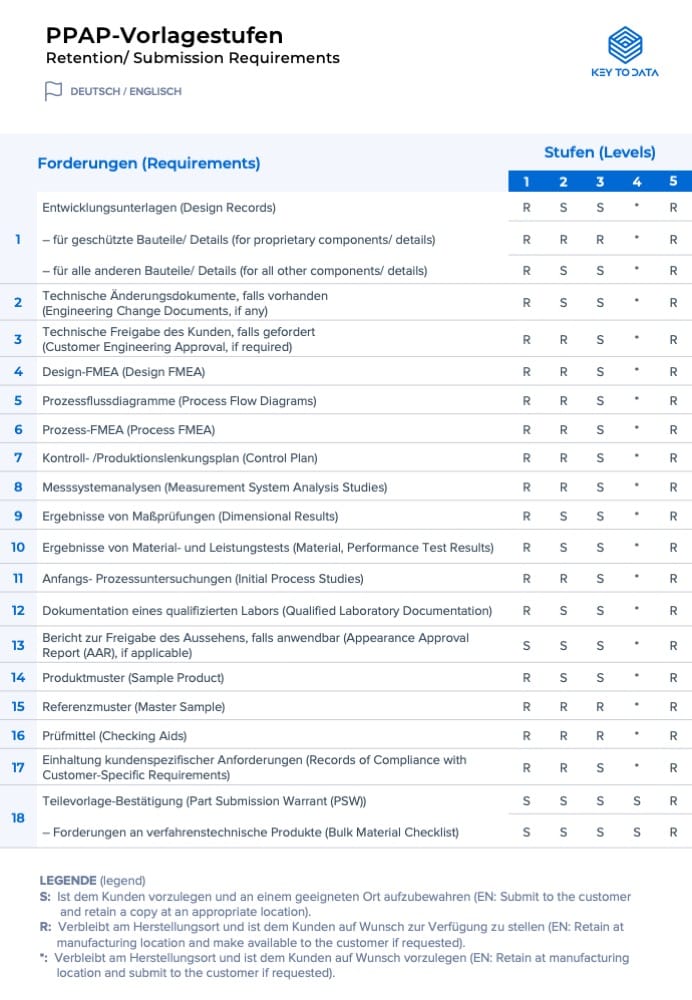
Folgend werden nun 18 mögliche Inhaltsbestandteile des Produktionsteilabnahmeverfahren (PPAP) genauer vorgestellt, erst in Form einer Liste, anschließend werden die PPAP-Forderungen in einzelnen Absätzen noch einmal genauer erläutert. Eine Übersicht der PPAP-Vorlagestufen in der Listenansicht finden Sie weiter unten auch zum Download.
- Stufe 1
- Stufe 2
- Stufe 3
- Stufe 4
- Stufe 5
| Requirement (Forderung / DE) | Stufe 1 | Stufe 2 | Stufe 3 | Stufe 4 | Stufe 5 |
| Requirement (Forderung / DE) | PPAP-Level 1 | PPAP-Level 2 | PPAP-Level 3 | PPAP-Level 4 | PPAP-Level 5 |
| 1. development documents (Design Records) | R | S | S | * | R |
| - for proprietary components/ details (for proprietary components/ details) | R | R | R | * | R |
| - für alle anderen Bauteile/ Details (for all other components/ details) | R | S | S | * | R |
| 2. technical change documents, if available (Engineering Change Documents, if any) | R | S | S | * | R |
| 3. technical approval of the customer, if required (Customer Engineering Approval, if required) | R | R | S | * | R |
| 4. Design FMEA (Design FMEA) | R | R | S | * | R |
| 5. Process Flow Diagrams (Process Flow Diagrams) | R | R | S | * | R |
| 6. Process FMEA (Process FMEA) | R | R | S | * | R |
| 7. control/production control plan (Control Plan) | R | R | S | * | R |
| 8. measurement system analyses (Measurement System Analysis Studies) | R | R | S | * | R |
| 9. Dimensional Results (Dimensional Results) | R | S | S | * | R |
| 10. Material, Performance Test Results (Material, Performance Test Results) | R | S | S | * | R |
| 11. Initial Process Studies (Initial Process Studies) | R | R | S | * | R |
| 12. Qualified Laboratory Documentation (Qualified Laboratory Documentation) | R | S | S | * | R |
| 13. appearance release report, if applicable (Appearance Approval Report (AAR), if applicable) | S | S | S | * | R |
| 14. Sample Product (Sample Product) | R | S | S | * | R |
| 15. Master Sample (Master Sample) | R | R | R | * | R |
| 16. Checking Aids (Checking Aids) | R | R | R | * | R |
| 17. Records of Compliance with Customer-Specific Requirements (Records of Compliance with Customer-Specific Requirements) | R | R | S | * | R |
| 18. part template confirmation (Part Submission Warrant (PSW)) | S | S | S | S | S |
| - Requirements for process engineering products (Bulk Material Checklist) | S | S | S | S | S |
Overview table of the PPAP Process Requirements: German and English
Requirements 1 to 18 and respective the Submission Levels 1 to 5.
Legend: S | R | *
- S: Ist dem Kunden vorzulegen und eine Kopie an einem geeigneten Ort aufzubewahren
(EN: Submit to the customer and retain a copy at an appropriate location). - R: Verbleibt am Herstellungsort und ist dem Kunden auf Wunsch zur Verfügung zu stellen
(EN: Retain at manufacturing location and make available to the customer if requested). - *: Verbleibt am Herstellungsort und ist dem Kunden auf Wunsch vorzulegen
(EN: Retain at manufacturing location and submit to the customer if requested).
Overview of the PPAP Submission Requirements
(PPAP Submission Levels Template)
TABLE: GERMAN - ENGLISH
PDF-Download
Inhaltsbestandteile des Produktionsteil-Abnahmeverfahren (PPAP)
PPAP-Forderung
1. Design Records (Entwicklungsunterlagen)
„Design Records“ zeigen meist eine Zeichnung des Bauteils, die üblicherweise vom Kunden bereitgestellt wird. Jedes Merkmal der Zeichnung muss gestempelt werden, damit es mit den Prüfergebnissen übereinstimmt. Dazu gehören Notizen, Standardtoleranzinformationen und Spezifikationen sowie alle weiteren Informationen, die für die Entwicklung des Bauteils relevant sind.
Example: Below is an example of a ballooned part drawing.
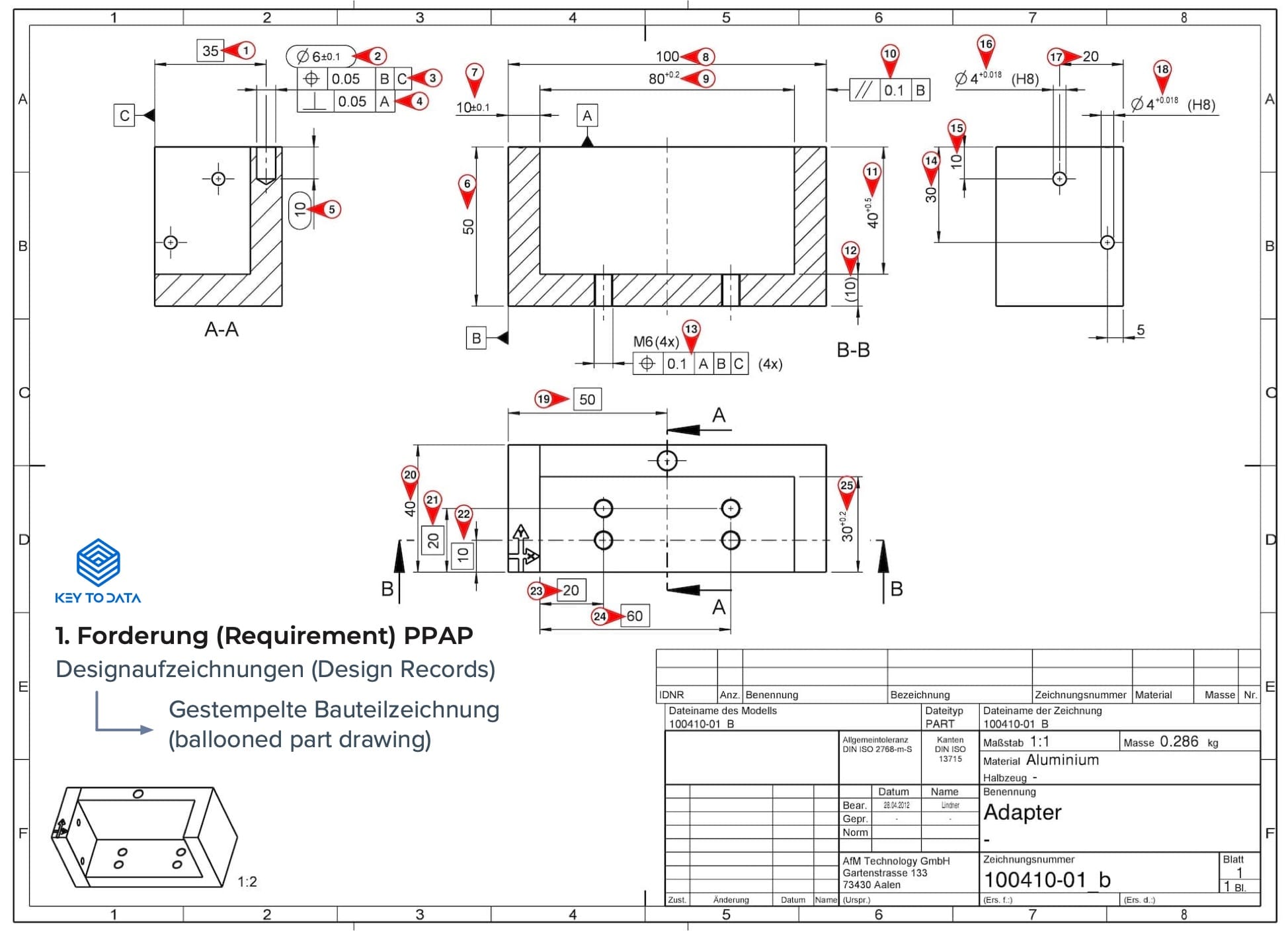
Why a copy of the part drawing belongs in your PPAP?
It shows the customer that you have a copy of the part drawing and makes sure that you are both discussing the same part.
Video: Creating a dimensional report for PPAP
Im folgenden Video zeigen wir Ihnen, wie Sie mit der FAIR-Software Ideagen Quality Control, eine Prüfzeichnung für PPAP erstellen.
You are currently viewing a placeholder content from Vimeo. To access the actual content, click the button below. Please note that doing so will share data with third-party providers.
More InformationPPAP-Forderung
2. Engineering Change Documents
A document showing the detailed description of a change, which is usually called a "technical change note". This document is only required when a change has been made.
PPAP-Forderung
3. Customer Engineering Approval
This approval is usually the engineering trial with sample production parts performed by the customer. A "temporary deviation" is often required to send parts to the customer before the PPAP is complete. Your customer may require other additional engineering approvals.
PPAP-Forderung
4. Design FMEA
With the Design-FMEA wird sichergestellt, dass das Designteam potenzielle Fehler des Produkts findet, bevor das Design abgeschlossen ist. Die Fehler werden dokumentiert, verbessert und zwischen Zulieferer und Auftraggeber kommuniziert.
FMEA ist die Abkürzung für Failure Mode and Effects Analysis, im Deutschen spricht man von einer Fehlermöglichkeits- und Einflussanalyse oder kurz Auswirkungsanalyse.
PPAP-Forderung
5. Process Flow Diagrams
The Process Flow Diagram shows all the steps required in the manufacturing of the part. It should include all of the main steps in the processing of the part including incoming components, measuring, and inspection. The Process Flow Diagram should match the control plan and the Process Failure Mode and Effects Analysis (PFMEA) and also includes the flow of non-conforming materials and parts.
PPAP-Forderung
6. Process FMEA
The Prozess-FMEA (Process Failure Mode and Effects Analysis) bewertet jeden Schritt im Produktionsprozess, um alle potentiell kritischen und fehleranfälligen Herstellungsschritte zu dokumentieren.
PPAP-Forderung
7. Control Plan
The Control Plan mirrors the PFMEA (Process Failure Mode and Effects Analysis) and provides more details on how potential issues are checked in the incoming inspection, assembly process, or during the inspection of the finished part.
PPAP-Forderung
8. Measurement System Analysis Studies
The Measurement Systems Analysis is a study itself and will conform to the customer's relevant ISO or TS standard. Typically it includes the Gauge R&R (Gauge Repeatability and Reproducibility) for the critical characteristics and a confirmation that gauges used to measure these characteristics are calibrated.
PPAP-Forderung
9. Dimensional Results
A list of all test characteristics stamped on the test mark including the measurement results. The list contains the product property, specification, measurement results and the evaluation showing whether the requirement is "fulfilled" or "not fulfilled" ("Ok" or "Not Ok"). Normally, at least 6 samples per product are tested.
Below is an example of a PPAP dimensional inspection results report. Learn more about creating a PPAP dimensional measurement report and how to import measurement results from CMMs into your dimensional inspection results.
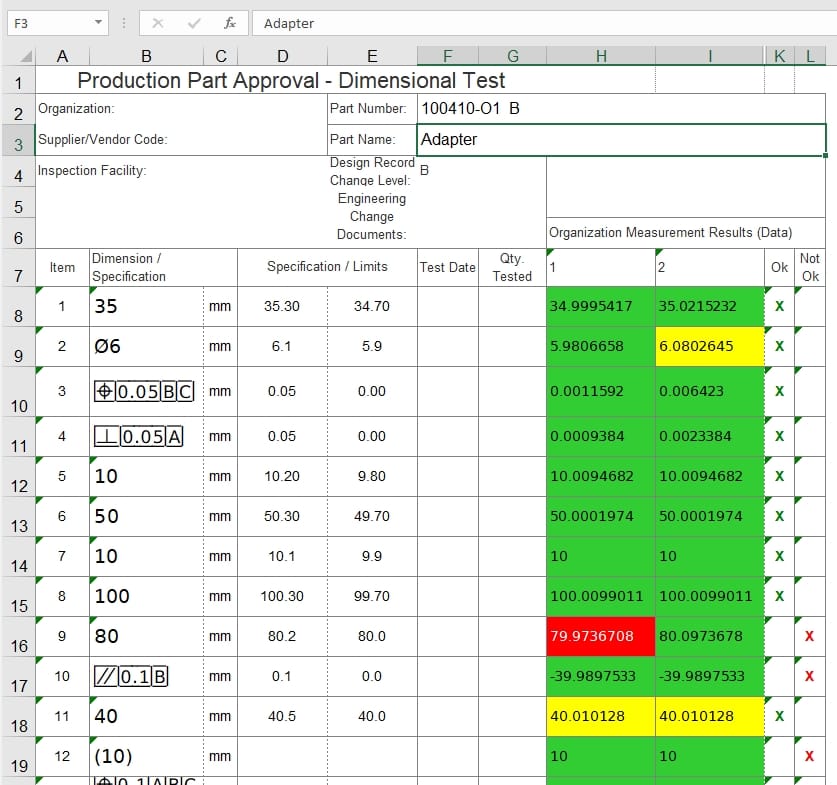
Image: PPAP measurement results (Dimensional Report)
PPAP-Forderung
10. Material, Performance Test Results
A summary of all tests that have been performed on the part. The summary should document any pass or fail inspection results. It should be signed off by the customer and the supplier to show that all required tests have been done and any additional data for tests have been submitted.
PPAP-Forderung
11. Initial Process Studies
Generally, this includes SPC (Statistical Process Control) charts for critical characteristics. These studies demonstrate that the critical processes are stable and are ready to begin the process validation builds.
PPAP-Forderung
12. Qualified Laboratory Documentation
Includes all of the industry certifications for any lab that was involved in completing validation testing.
PPAP-Forderung
13. Appearance Approval Report (AAR)
The Appearance Approval Report verifies that the customer has inspected the final product and it meets all the required appearance specifications for the design. The report includes color, textures as well as fit (gaps between parts), etc.
PPAP-Forderung
14. Sample Product
A picture of the production parts is included in the PPAP documentation along with the location where the parts are stored.
PPAP-Forderung
15. Master Sample
A sample part that is signed off by the customer and supplier. The master part is normally used to train operators on subjective inspections such as visual or for noise.
PPAP-Forderung
16. Checking Aids
Checking aids are used by production and are a detailed list of all the tools used to inspect test or measure parts during the assembly process. This aid will list the part, describe the tool and have the calibration schedule for the tool.
PPAP-Forderung
17. Records of Compliance with Customer-Specific Requirements
This section of the PPAP documentation lists requirements of specific industries and the individual requirements of the customer.

PPAP-Forderung
18. Part Submission Warrant (PSW)
The Part Submission Warrant is a summary of the entire PPAP submission and specifies:
- Drawing numbers and revisions
- Information about the part
- Test results
- Material declarations numbers
- Any deviations from earlier elements.
PPAP Excel-Template
Free of charge | English | Complete
Ideagen Quality Control
50% time saving in FAI-Report generation. Publish FAI-Reports according to VDA, PPAP, AS9102 or custom templates.
Free access for 14 days
Inspection reports in minutes, not hours
- Free training & support
- Full functionality
Difference between PPAP and APQP
PPAP ist eine Komponente von APQP:.
PPAP:
Deutsch: Produktionsteil-Freigabeverfahren
Englisch: Production Part Approval Process
APQP:
Deutsch: Produkt-Qualitätsvorausplanung und Steuerungsplan
Englisch: Advanced Product Quality Planning
How does PPAP affect APQP?
If the PPAP results don't meet customer expectations, that usually means the APQP process isn't working properly. The test for both APQP and PPAP is a production trial run. If the finished trial product includes defective parts, the manufacturer has to go over the supply chain and find out where PPAP or APQP went wrong.
Software distribution for over 25 years
KeyToData has been distributing highly specialised software for companies in the manufacturing industry since 1995.
Support without waiting on hold
We do not leave you alone during the implementation of new software. Even during ongoing software operation, we are always available to answer your questions.